Therapy Courses
6 EMDR Target Mapping Worksheets - SUDS, Cognitions + Done for you EMDR Digital Download pdf
6 EMDR Target Mapping Worksheets - SUDS, Cognitions + Done for you EMDR Digital Download pdf
Best for: Adults · Trauma & PTSD
- Instant PDF download
- Unlimited client use
- Print as many as you need
- Money-back guarantee
Couldn't load pickup availability
Buy 3 or more, save 20%. Use code 3ORMORE at checkout.
Or get this plus every resource in the shop with the Vault ($70 every 3 months). Learn more
EMDR target mapping is a way to organise candidate memories, related beliefs and current concerns for therapist-led treatment planning. This six-page PDF provides prepared worksheets for recording target-related information, including cognitions and subjective distress ratings.
Designed for appropriately trained EMDR practitioners, this is a paid digital resource for guided use. The worksheet supports documentation; it does not choose a treatment sequence, establish readiness or provide EMDR training.
Choose the 6-page EMDR Target Mapping PDF →
What does the EMDR Target Mapping PDF contain?
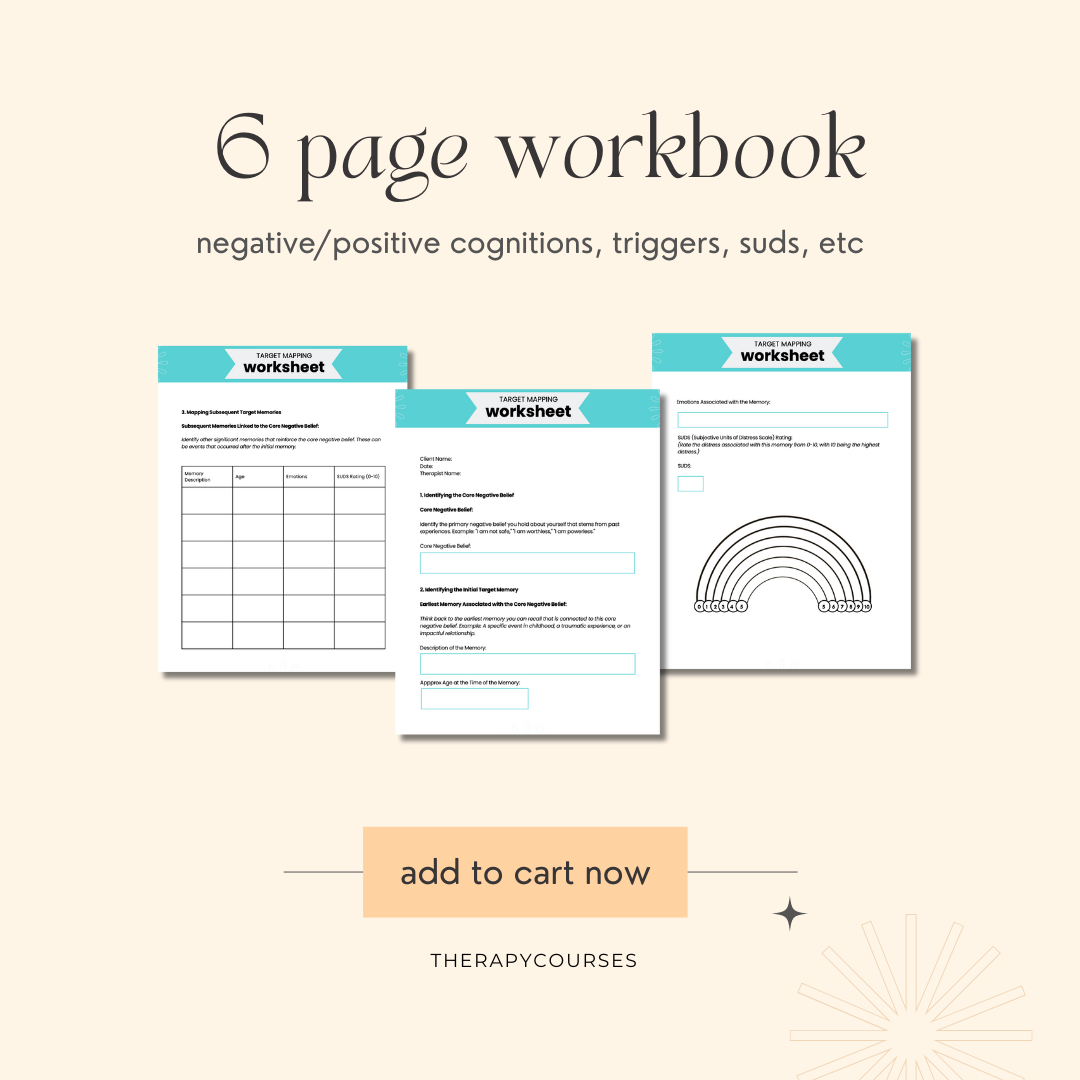
The six-page resource includes target-mapping worksheets with spaces to record beliefs, memory information and distress. The product gallery shows these fields:
| Visible worksheet field | What you can record |
|---|---|
| Client name, date and therapist name | The details needed to identify and date the working record. |
| Core negative belief | A belief expressed by the client, in their own words. |
| Initial target memory and approximate age | A brief description of a candidate memory and the age the client recalls. |
| Emotions and SUDS rating | The client's reported emotion and Subjective Units of Distress rating, where clinically appropriate. |
| Subsequent target memories table | Related memory descriptions, ages, emotions and ratings for review. |
The gallery also identifies negative/positive cognitions and triggers among the resource topics. Use the product images to review the layout before purchasing.
You receive a digital PDF, not a physical workbook. Print selected pages or view them on a device. Viewing a PDF digitally does not mean it has interactive fillable fields.
How to use an EMDR target-mapping worksheet
EMDR history taking and treatment planning are part of a wider clinical process. A map can organise information gathered in that process, while assessment, preparation, target selection and sequencing remain with the trained practitioner.
Materials: a worksheet or blank paper and your approved clinical-record system. Purpose: record a working formulation clearly enough to review and revise. This example is about documentation, not a reprocessing exercise.
- Agree on the scope. Say: “We can record brief labels for the experiences we have discussed. You do not need to retell them in detail to complete this page. We can leave a field blank or pause.” Use information already appropriately gathered in the session.
- Record the client's words. Ask: “Is this wording accurate, or would you change it?” Keep reported beliefs and experiences separate from the therapist's hypotheses.
- Make uncertainty visible. Use “approximate”, “not yet discussed” or “to review” rather than filling gaps with assumptions. A blank rating is preferable to an invented one.
- Review possible links. Ask: “Do these experiences seem connected to you, or should we keep them separate for now?” Record uncertainty when the connection is unclear.
- Choose a planning action. That might be further assessment, preparation, consultation or revisiting the map. The worksheet alone does not determine which memory to process first.
Keep identifying information and completed worksheets within your practice's approved record arrangements. Let the client know how the information will be used.
Illustrative documentation example
Fictional case: Taylor and their therapist have already discussed feeling judged during presentations. They agree to make a brief working record without going into the experiences again.
| Item | Illustrative entry |
|---|---|
| Client's reported belief | “I am not good enough.” |
| Candidate memory | “School presentation” — brief label only. |
| Approximate age | “About 14”, as reported by Taylor. |
| Reported emotion | Embarrassment. |
| SUDS | Not collected in this documentation example. |
| Current concern | An upcoming presentation at work. |
| Working link | Possible shared theme of judgement; review with Taylor. |
| Planning note | Review assessment and preparation needs before agreeing on any processing plan. |
The current-concern and planning notes illustrate what a clinician might record alongside the worksheet; they are not a claim that every row above has a dedicated field in the PDF. This invented example shows how to distinguish reported information, uncertainty and next steps. It is not a recommended target order or an indication that Taylor is ready for reprocessing.
Adapt the documentation to the client
- If writing is difficult: record the client's words with permission, then read them back for correction.
- If dates are uncertain: use an approximate age or leave the field open. Do not treat recall as a precise historical record.
- If the discussion becomes overwhelming: pause mapping and return to the agreed clinical support approach.
- If using telehealth: use your approved document-sharing method. Avoid putting client details in ordinary chat or a shared link.
Which EMDR resource do I need?
- Focused target documentation: choose this six-page target-mapping PDF.
- A history-taking template: compare the EMDR History Taking Worksheets.
- A broader practitioner resource collection: review the contents of the EMDR Worksheets Bundle. Check for overlapping materials before buying both.
- Client-facing explanation and preparation materials: explore the separate EMDR Client Handouts.
For help selecting resources by session purpose, read our EMDR worksheets guide for therapists.
Prepared target-mapping pages for your practice
The documentation example above can be recreated on plain paper. Choose the paid PDF if you want a prepared six-page layout for recording and reviewing target-related information.
Professional use: choose the Therapist licence for client use. The current licence is for a single practitioner; it does not permit sharing with peers, uploading online, resale or use in a paid course. Review the applicable licence when selecting your purchase option.
View purchase and licence options for the EMDR Target Mapping PDF →
Frequently asked questions
What is the difference between EMDR target mapping and history taking?
History taking gathers the broader clinical information used in assessment and treatment planning. A target map organises candidate memories and related information within that process. The two resources serve related but different documentation tasks.
Does a target map tell me which memory to process first?
No. Target selection and sequencing depend on clinical assessment, the formulation, preparation, consent and the practitioner's training. A worksheet records information; it does not make those decisions.
Is this the complete EMDR protocol?
No. It is a focused six-page mapping resource, not a complete treatment protocol, certification or training course.
Is the EMDR target-mapping PDF free?
No. This is a paid digital product. The on-page documentation example is available to read and recreate without buying it.
Can clients use it to do EMDR on their own?
This resource is intended for therapist-guided use by appropriately trained EMDR practitioners. It is not a self-directed trauma-processing programme.
Will I receive a printed book or an editable form?
This listing is for a digital PDF. No physical book is sent. Interactive fillable fields are not promised by this description.
Can I use these with my clients?
Can I use these with my clients?
Yes! Use them with as many clients as you like, for as long as you like. They're not for resale or for use inside a course you sell.
I am not a therapist, can I use these on my own?
I am not a therapist, can I use these on my own?
Yes! These worksheets can be used by anyone wanting to learn about the topics. They are not for use in crisis or emergency situations.
How do I integrate these into my practice?
How do I integrate these into my practice?
All of our worksheets are print ready. So just choose the pages you want to print and off you go. You can give them to clients to take home or use them for your notes. We also offer some digital worksheets.
Shipping & Delivery
Shipping & Delivery
Most items are instant access via email. These products will be noted as 'digital download'. The physical workbooks will also be noted. They are POD meaning that the book will only be printed once the order is placed. Once the order is placed the book will print in 2-3 days and shipping usually takes up to 7 days.
Return Policy
Return Policy
We offer free returns & money back guarantee on all products. If you don't like what you purchased just let us know and we will refund your money.